Key points
- Clamp order: red to dead positive, red to donor positive, black to donor negative, last black to a bare metal earth point on the dead car.
- Remove the leads in the exact reverse order and never let the clamps touch each other.
- Do not jump a battery that is swollen, cracked, leaking or frozen.
- If the car has jump posts under the bonnet, use them instead of the battery terminals.
- A jump start gets the engine running. It does not fix the battery, so have it tested afterwards.
Before you connect anything
Look at the battery first. If the case is swollen, cracked or wet with acid, or there is a strong rotten-egg smell, do not jump it. A damaged battery can vent flammable gas and a spark can ignite it. A frozen battery, which is rare in the UAE but possible on cars brought from cold climates, must not be jumped either.
Check both owner manuals. Some manufacturers do not allow a hybrid or electric car to be used as the donor, because its 12V system is not designed to supply starting current to another vehicle. Both cars must be 12-volt. Switch off both ignitions, lights, AC and audio, apply the parking brakes and keep the cars from touching each other.
Jump start with jump leads, step by step
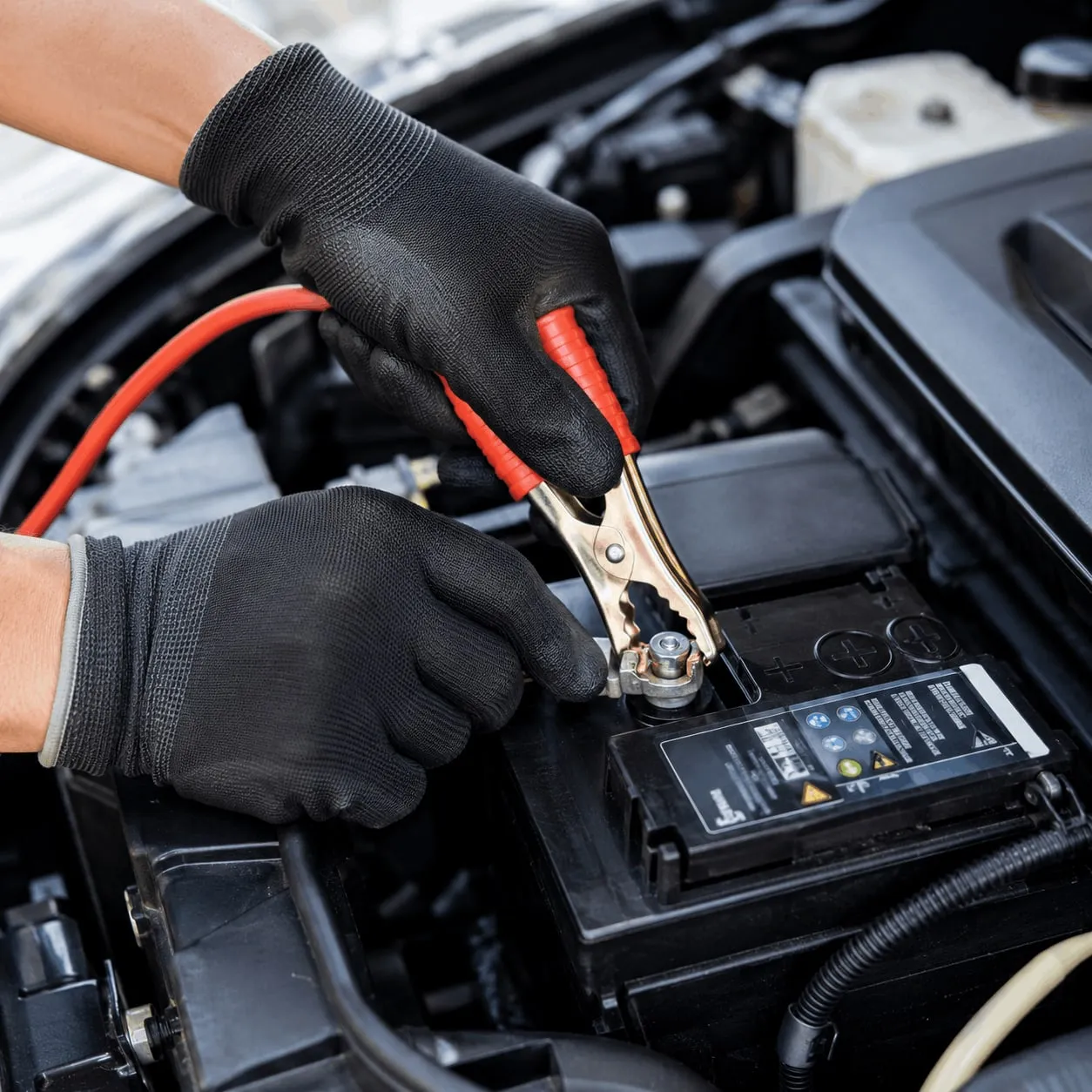
Use leads that are thick enough for the engine size, with clean clamps and no damaged insulation. Park the donor car close enough for the leads to reach without stretching. Put automatics in Park and manuals in neutral. Then follow the order below exactly. The order exists to keep the final spark away from the battery.
- Clamp one red lead to the positive (+) terminal of the dead battery.
- Clamp the other red end to the positive (+) terminal of the donor battery.
- Clamp one black lead to the negative (-) terminal of the donor battery.
- Clamp the last black end to a bare metal earth point on the dead car, such as an engine lifting bracket or a marked earth stud, away from the battery and from moving parts.
- Start the donor car and let it run for a few minutes.
- Try to start the dead car. If it does not start, wait a few more minutes and try again. Keep each attempt short.
- Once it runs, remove the leads in reverse order: black from the earth point, black from the donor, red from the donor, red from the revived car.
Jump start with a booster pack
A portable booster pack does the same job without a second car, which makes it the practical tool in basements and tight parking bays. Check that the pack is charged and rated for your engine. Read its instructions, because some packs have a boost button, a reverse-polarity warning or a waiting time between attempts.
- With the pack switched off, clamp red to the positive (+) terminal or jump post of the car.
- Clamp black to a bare metal earth point, or to the negative terminal if the pack instructions say so.
- Switch the pack on and start the car. Keep each attempt to a few seconds.
- When the engine runs, switch the pack off, remove black first, then red.
Modern cars with remote jump posts
On many modern cars the battery is in the boot, under a seat or under a cover in the floor. These cars usually have dedicated jump posts under the bonnet: a positive post under a red cap marked with a plus sign, and an earth stud or marked metal point for the negative. Always use these posts when the manual shows them.
Do not clamp directly to the negative terminal on a car that has a battery sensor fitted there. The sensor measures current flowing through that terminal, and clamping past it can damage it or confuse the battery management system. The earth point that the manufacturer marks is the safe place.
What not to do
- Do not let the red and black clamps touch each other or let a red clamp touch the car body.
- Do not reverse the polarity. Red on negative can destroy fuses, control units and the alternator in seconds.
- Do not smoke or use a naked flame near the battery.
- Do not crank for long periods. Repeated long attempts overheat the starter and the leads.
- Do not lean over the battery while connecting or starting.
- Do not use thin, damaged or corroded leads.
How long to drive afterwards
Keep the engine running and drive for at least 30 minutes if you can, preferably on an open road and not in stop-start traffic. Avoid switching the engine off until you reach somewhere safe to be stranded again. This puts some charge back, but an alternator is not a battery charger and will not fully restore a deeply discharged battery.
What happens at the next start tells you a lot. If the cause was obvious, such as lights left on overnight, the battery may recover. If there was no clear cause, or the car struggles again the next morning, the battery is probably at the end of its life or something is draining or not charging it. A battery test settles it.
When to call a technician instead
Call a technician if the battery looks damaged, if you cannot find the jump posts, if no donor car can reach yours, if you are on a live road shoulder, or if the car has already been jumped once this week. A mobile technician brings a professional booster and a tester, starts the car, then checks the battery and the charging system on the spot.
800MyBatt runs a 24/7 jump start service across Dubai, Abu Dhabi and Sharjah. Send your location pin on WhatsApp with the car make and model. You get an arrival estimate before dispatch, which depends on your location, traffic and access. If the test shows the battery cannot hold charge, it can be replaced there and then.
Reviewed by technicians who test and fit car batteries across the UAE every day.