Key points
- Battery faults show before the engine starts: slow crank, rapid clicking, lights that fade as you turn the key.
- Alternator faults show with the engine running: battery light on, dimming lights, a car that dies again after a jump start.
- Starter faults leave the lights bright and steady, and a jump start makes no difference.
- About 12.6V rested means a full battery. Roughly 13.7 to 14.7V with the engine running means the system is charging.
- A new battery that dies again points to the charging system or a parasitic drain, not to the battery.
What each of the three parts does
The three parts work as a chain. The battery stores energy and supplies the large current needed to start. The starter motor uses that current to turn the engine until it fires. Once the engine runs, the alternator powers the car's electrics and recharges the battery. A fault in any one can leave you with a car that will not start.
Symptoms that point to the battery
A battery at fault usually shows itself before the engine starts. The crank is slow, or you hear rapid clicking, and the dashboard lights dim sharply as you turn the key. The car normally starts with a jump start and then runs properly. If it will not restart after being parked for a few hours, the battery is not holding charge.
History helps. A battery over two years old in UAE heat, a car that has stood unused, an interior light left on, or a string of short trips all point to the battery. Remember that a flat battery and a failed battery are different things: a healthy battery drained by a light left on can often be recharged and kept.
Symptoms that point to the alternator
An alternator fault shows itself with the engine running. The battery warning light comes on, headlights dim or flicker, and electrical items may behave oddly. A whining or grinding noise from the engine bay or a squealing belt can go with it. Eventually the battery runs down and the engine cuts out, sometimes while driving.
The classic pattern is a car that starts with a jump, runs for a while, then dies again or will not restart at the next stop. The battery was never the problem, it was simply not being recharged. Fitting a new battery in this case gets you moving only until that one is flat as well.
Symptoms that point to the starter
With a starter fault the electrics look healthy. The lights are bright and the dashboard stays lit, but turning the key gives a single heavy click, a whirring or grinding noise, or silence. A jump start makes no difference. The fault may come and go at first, with the car starting on the second or third attempt.
Before blaming the starter, check the simple things. Loose or corroded battery terminals and a poor earth strap can produce the same single click. On an automatic, make sure the selector is fully in P or N. A flat key fob battery or an immobiliser fault will also stop cranking, usually with a warning on the dash.
Battery, alternator and starter compared
The table puts the three side by side. Read across each row and see which column matches what your car is doing. Real faults overlap, and a failed alternator will leave you with a flat battery as well, so use this to decide what to test first and not as a final answer.
| Check | Battery | Alternator | Starter |
|---|---|---|---|
| When you turn the key | Slow crank or rapid clicking | Normal at first, later like a flat battery | Single click, grinding or nothing |
| Dashboard and lights | Dim, and fade during cranking | Battery light on, lights dim or flicker when running | Bright and steady |
| Does a jump start help | Yes, usually | Starts, then dies again | No |
| While driving | Normal | Warning light, electrics fade, engine may cut out | Normal once started |
| Rested voltage, engine off | Low, well under 12.6V | Often low, because the battery is not being charged | About 12.6V |
| Voltage with engine running | Roughly 13.7 to 14.7V | Stays near the resting figure, or reads unusually high | Roughly 13.7 to 14.7V |
Simple voltage checks with a multimeter
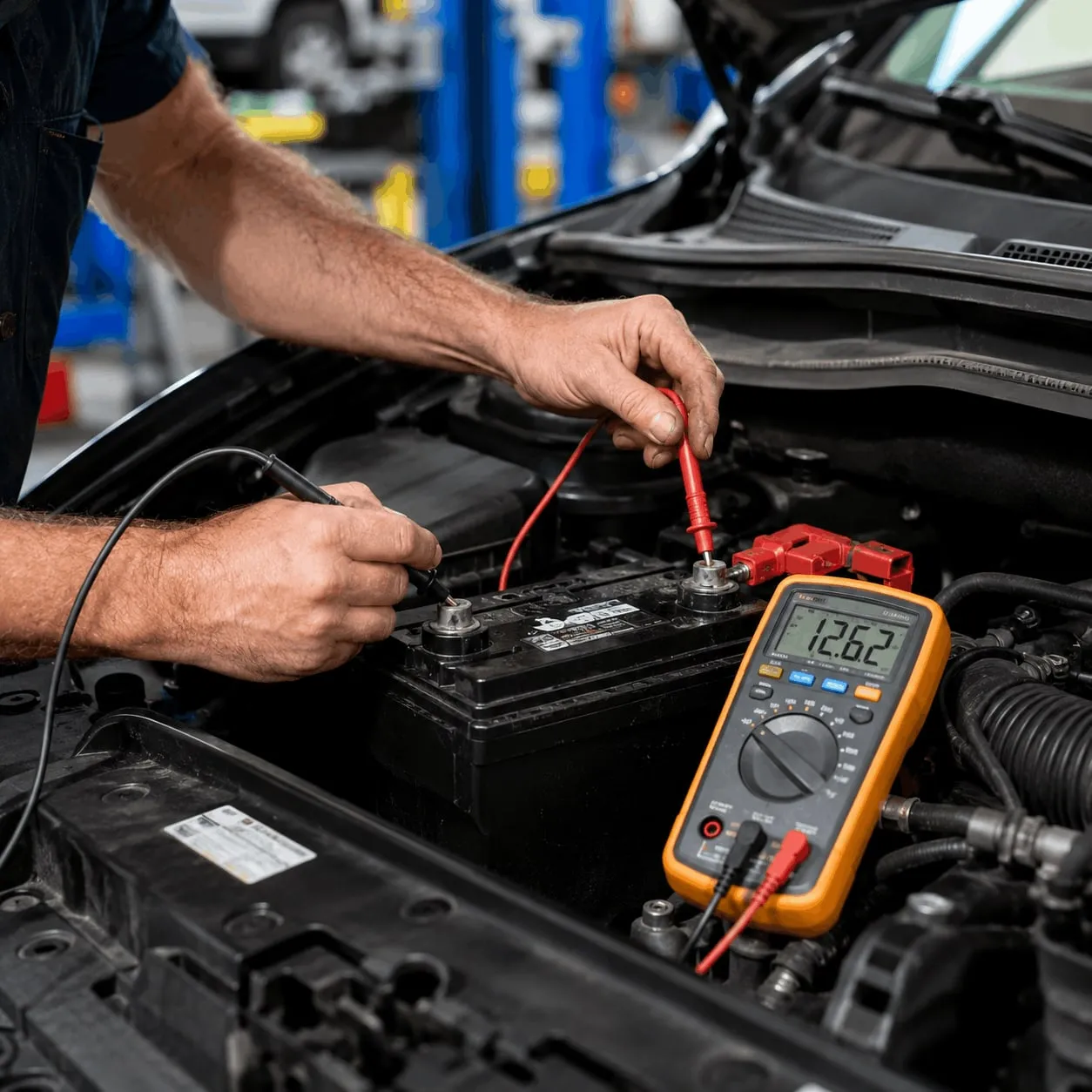
A basic multimeter set to DC volts gives useful clues. Measure across the battery terminals with the engine off, after the car has rested for a few hours. A fully charged battery reads about 12.6V. A reading near 12.2V means it is roughly half charged, and around 12.0V or less means it is close to flat.
Then start the engine and measure again. A healthy charging system usually shows roughly 13.7 to 14.7V. If the reading stays near the resting figure, the alternator is not charging. Smart alternators on many newer cars vary their output on purpose and can read lower at times, so one low reading on those cars is not proof of a fault.
Voltage has limits. A worn battery can show 12.6V at rest and still collapse under load, which is why technicians use a conductance or load tester that measures cranking ability against the rating on the label. Keep fingers, clothing and meter leads clear of belts and fans when the engine is running.
Why a new battery dies again
A new battery that goes flat within days or weeks is rarely a bad battery. The usual causes are a charging system that is not replacing what the car uses, or a parasitic drain that empties the battery while the car is parked. Common drains are a boot or glovebox light that stays on, an aftermarket tracker, alarm or dashcam, and a control unit that does not go to sleep.
Have the charging voltage and the parked current draw measured before claiming on the warranty or buying again. 800MyBatt technicians test the battery and charging output where the car is, in Dubai, Abu Dhabi and Sharjah, day or night. If the result points to the alternator or starter, we tell you, and the car can go to a workshop for that repair.
Reviewed by technicians who test and fit car batteries across the UAE every day.